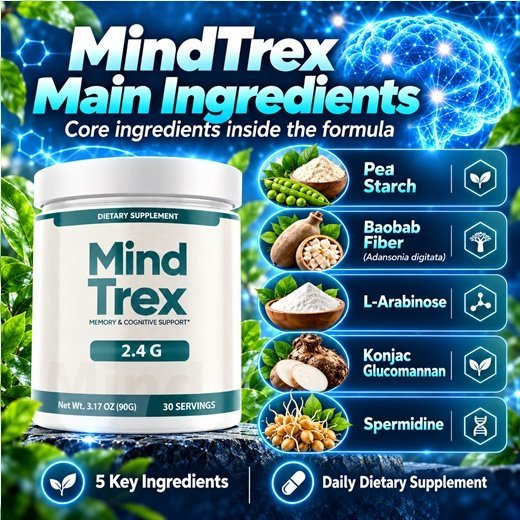
MindTrex ingredients at a glance
| Ingredient | What it is | Main role in the formula | Typical research dose |
|---|---|---|---|
| Pea starch | Plant carbohydrate | Texture and carrier | Not applicable |
| Baobab fiber | Fruit pulp fiber | Prebiotic fiber, polyphenols | Roughly 15 to 40 g of pulp in meal studies |
| L-arabinose | Plant sugar | Slows sucrose digestion | A few grams alongside sugar |
| Konjac glucomannan | Soluble root fiber | Gel-forming fiber | 3 to 4 g per day |
| Spermidine | Natural polyamine | Cellular maintenance | About 1 mg per day in human trials |
Because the entire MindTrex serving weighs about 2.4 g, the fiber ingredients are almost certainly present at lower amounts than in most studies. Spermidine is effective in milligram amounts, so its dose could be in range, but we can't confirm it.
1. Pea starch
Pea starch comes from yellow peas. In powdered supplements it provides bulk and helps the powder dissolve smoothly. Part of pea starch resists digestion and reaches the colon, where it behaves somewhat like fiber. In MindTrex it's best thought of as the base of the blend rather than an active ingredient.
2. Baobab fiber (Adansonia digitata)
The baobab tree grows across Africa, and its dried fruit pulp is naturally high in soluble fiber, vitamin C and polyphenols. In a small study, adding baobab extract to white bread lowered the blood sugar response to the bread. Its fiber also feeds gut bacteria, which is why it is often described as a prebiotic. We found no human study on baobab and memory or attention.
3. L-arabinose
L-arabinose is a sugar found in plant cell walls, in foods such as corn fiber and sugar beet pulp. It partly blocks sucrase, the enzyme that splits table sugar into glucose and fructose. Human studies show that adding L-arabinose to a sugary drink can reduce the rise in blood sugar and insulin that follows. The benefit mainly applies when you consume sucrose, so it may matter less if your diet is already low in sugar.
4. Konjac glucomannan
Glucomannan comes from the root of the konjac plant. It can absorb many times its weight in water, forming a thick gel. This slows digestion, increases fullness and supports regularity. It's one of the few fibers with regulatory-approved health claims in Europe, for weight loss and cholesterol at 3 to 4 g a day.
That swelling is also its main safety issue. Dry glucomannan tablets have caused throat and esophagus blockages, which is why powders must be fully mixed with plenty of water. See our MindTrex side effects guide for details, and how to take MindTrex for safe mixing.
5. Spermidine
Spermidine is a polyamine found in every cell and in foods such as wheat germ, soybeans, mushrooms, peas and aged cheese. It activates autophagy, a cellular recycling process, and is a popular subject in healthy-aging research. Most human supplement studies use wheat germ extracts providing around 1 mg per day.
It's also the ingredient most tied to memory claims. However, a 12-month trial published in 2022 found no significant memory benefit in older adults compared with placebo. Our does MindTrex work? page explains the research in more detail.
What's not in MindTrex
Many buyers assume a brain supplement contains classic nootropics. MindTrex doesn't list caffeine, L-theanine, bacopa, ginkgo, lion's mane, citicoline, omega-3s or B vitamins. That makes it stimulant-free, but it also means none of the ingredients with the most cognitive research are included. If those interest you, see MindTrex alternatives.
The label you receive may also list flavoring or sweetener. Always check the supplement facts panel on your jar, especially if you have allergies or sensitivities.
The proprietary blend problem
Supplement makers may group ingredients into a named blend and disclose only its total weight. It's legal, but it prevents you from checking whether each ingredient is present at a meaningful dose. For MindTrex, it means we can't tell whether you're getting 1 g of konjac or 100 mg, or how much spermidine is in each scoop. We think this is the biggest weakness of the formula. Our overall scoring is in the MindTrex review.
Frequently asked questions
Does MindTrex contain caffeine?
No. Caffeine is not listed among the MindTrex ingredients.
Is MindTrex vegan?
The listed ingredients are plant-based or produced without animal sources, but check the label on your jar for any additives.
How much spermidine is in MindTrex?
The amount isn't disclosed because it's part of a proprietary blend. Only the total 2.4 g serving weight is listed.
Related MindTrex guides
Ready to decide on MindTrex?
Order from the official page so your purchase is covered by the refund policy.
Check the current MindTrex priceShips from the official order page with a 60-day money-back guarantee. We may earn a commission if you buy through this link.
Disclosure: Independent information site. We are not the manufacturer or the official seller of MindTrex. Some links are affiliate links: if you buy through them, we may earn a commission at no extra cost to you. This page is for general information and is not medical advice. Last updated: September 2026.